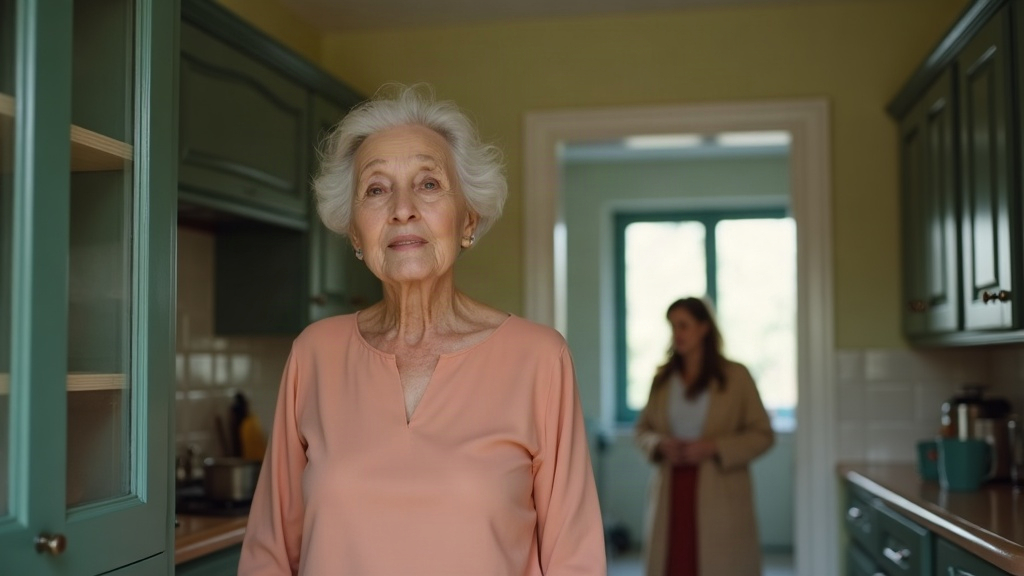
Mom Charmed the Doctor for 15 Minutes. At Home She Can't Find the Kitchen. What Families Do When the Appointment Only Saw the Performance
The Version of Your Parent the Doctor Sees
I want you to know something before we go any further: what you are experiencing has a name, and you are not imagining it.
I have sat with enough families over the years, first as an emergency physician and now in this work, to recognize the particular exhaustion in the voice of someone who says, "She was so sharp in there. She answered every question. She made a joke. And then we got home and she couldn't remember whether she'd eaten lunch." There is confusion in that voice, and frustration, and sometimes a little guilt, as if they should be relieved but they are not. What they are, mostly, is bewildered. Because they know what they saw. And what the doctor saw was something else entirely.
The medical community has a term for this: showtiming. It is not manipulation, exactly, and it is not a choice in the way we usually think of choices. It is something closer to a deeply human reflex, a gathering of every remaining resource to present well in a high-stakes moment. Your parent, on some level, understands that the doctor's office is a place where something important is being evaluated. And so they rise to it. They are charming, oriented, and articulate. They remember the grandchildren's names. They reassure the doctor that everything is fine, really, just a little tired lately.
And then the appointment ends, and so does the performance. Not because they were faking. But because that kind of effort is exhausting, and the baseline reasserts itself the moment the pressure lifts.
You drive home. She can't find the kitchen.
Why the Appointment Was Never Going to Catch This
Here is what I want you to understand about your doctor, because it matters: they are not missing this because they are not paying attention. They are missing it because a fifteen-minute appointment was never designed to catch it. The physician sitting across from your mother is working inside a structure that gives them a narrow window, a standardized set of screening questions, and a documentation burden that starts the moment the visit ends. They want to give her more time. Most of them would tell you that themselves, if you asked. But the appointment slot is not their decision, and neither is the volume of patients on their schedule. Those are decisions made at the administrative and insurance level, and they squeeze every physician who is trying to do right by their patients.
A standard cognitive screening tool, the kind used in a primary care visit, is designed to catch moderate to severe impairment. It was not built to detect the early and middle stages of decline in someone who is motivated to perform well, who is educated, who has good social skills, and who has had decades of practice being competent and capable. Your mother may pass it with flying colors. That does not mean she is fine. It means she is good at the test at that moment.
The problem is not the doctor's judgment. The problem is that the data going into that judgment is incomplete. The doctor is making a call based on a fifteen-minute snapshot, and the snapshot looks good. What they are not seeing is the two hours it took her to get dressed that morning, or the pot she left on the stove last Tuesday, or the fact that she has stopped driving but won't say why. That information exists. It just lives with you, not in her chart.
Getting the Real Picture Into the Record
This is where I want to slow down with you, because this is the part that actually changes things. The goal is not to override the doctor's assessment or to argue with your mother in the exam room. The goal is to make sure the physician has access to the full picture, not just the picture she presents. There are concrete ways to do that.
Write It Down Before the Appointment, Not During
Families often try to bring up concerns in the room, while their parent is sitting right there. It rarely goes well. Your mother deflects, minimizes, or gets upset. The doctor, reading the room, may table the conversation to preserve the relationship with the patient. And you leave having said a fraction of what you needed to say.
Instead, write a letter or a brief summary before the appointment and send it ahead, or hand it to the nurse when you arrive with a simple request: please make sure the physician sees this before they come in. Keep it factual and specific. Not "she seems confused sometimes," but "in the past three weeks, she has gotten lost driving to the grocery store she has gone to for twenty years, left the stove on twice, and called me by her sister's name on four separate occasions." Dates and specifics matter. Vague concern is easy to reassure away. Documented, specific observations are harder to set aside.
Ask for the Right Kind of Evaluation
If you believe there is genuine cognitive change happening, a brief screening in a primary care office is not the same thing as a full neuropsychological evaluation. You can ask, specifically, for a referral to a neurologist or a geriatric psychiatrist, or for formal neuropsychological testing. These are longer, more structured assessments that are designed to detect the kind of performance variability your mother is showing. A physician who has only seen the fifteen-minute version may not have thought to order it yet. That does not mean they would refuse if you asked.
You are allowed to ask. That is not overstepping. That is participating in your parent's care.
A free, quick assessment to help you see where you stand and whether independent patient advocacy is the right next step for you.
Take the free assessment →Request a Caregiver Visit or a Separate Conversation
Many physicians, when asked directly, will agree to a brief phone call or a separate visit with a family caregiver, without the patient present. This gives you a space to share what you are actually seeing without your mother needing to manage how she appears. It also gives the physician a second data point that they genuinely need. You can frame it simply: "I have some observations I'd like to share outside of the appointment so I don't put Mom in an uncomfortable position. Would you or someone on your team have ten minutes to talk with me?"
Some practices have care coordinators or social workers who handle exactly this kind of conversation. Ask whether that resource exists.
Keep a Simple Log at Home
You do not need to be a medical professional to document what you are observing. A running note on your phone, or a simple dated journal, that captures specific incidents becomes a powerful piece of evidence over time. When you bring that log to a future appointment and say, "Here are fourteen specific examples from the past six weeks," it is much harder to attribute to normal aging or caregiver anxiety. It also helps you, because caregiving can be disorienting, and having a record reminds you that what you are seeing is real and consistent, not a one-time bad day.
When the Specialists Disagree, or When You Are Sent Home With "She Seems Fine"
Sometimes families do everything right. They send the letter. They ask for the evaluation. They share the log. And they still leave with a reassurance that does not match what they are living with. This is one of the most demoralizing experiences in caregiving, and I want to be honest with you about it rather than gloss over it.
When the medical record shows a patient who presented well, passed a screening, and denied significant symptoms, it is genuinely difficult to move the conversation forward inside the system that generated that record. The chart now says she's fine. Every subsequent visit starts from that baseline.
This is the moment when having someone truly independent, not connected to her hospital system, not billing through her insurer, not constrained by the same appointment-length pressures, can make a real difference. Not because her doctors are wrong to trust what they saw, but because an independent review can look at the full picture: the chart, your documented observations, the pattern over time, and the gap between what the record shows and what the family is living with. That kind of review can produce documentation that gives her physician something new to work with, a reason to look again, or a referral they had not yet considered.
I left emergency medicine in part because I kept watching families arrive at crisis points that did not have to happen. Situations where the decline had been visible for months, but nobody had helped the family get that visibility into the right hands. That is the work I do now, and I believe in it precisely because I have seen what happens on both ends.
What This Is Not About
I want to name something directly, because families in this situation sometimes carry a quiet guilt that I think is worth addressing. Pushing for a more complete evaluation is not an act of disloyalty to your mother. It is not undermining her independence or treating her like she cannot speak for herself. It is recognizing that the version of herself she presents in a high-stakes moment is not the whole picture, and that decisions made on an incomplete picture can have real consequences for her safety and her quality of life.
She may not like it. She may be angry, for a while. That is a real thing, and it is not nothing. But the alternative, waiting until a fall or a crisis forces the conversation, often results in decisions being made under emergency conditions, with far less time to consider what she would actually want.
Your instincts brought you here. Those instincts are data too.
A Last Thought Before You Walk Into That Next Appointment
The system was not built to catch what you are seeing. That is a structural failure, not a reflection of anyone's competence or care. Your mother's doctor is probably doing the best they can inside a framework that was never designed for the kind of nuanced, longitudinal observation that early cognitive change requires. And you, as a family member, are doing the best you can inside a situation nobody prepared you for.
But knowing the mechanism, understanding why the fifteen-minute appointment doesn't see what you see, changes your position inside it. You are not powerless. You have information the doctor needs. The question is how to get it into the room in a form that can actually be heard and used.
That is something you can learn to do. And you do not have to figure it out alone.
With care,
Dr. Tabu Terrell, MD
HealthStrategix
Frequently Asked Questions
Is showtiming a sign that my parent knows something is wrong?
Not necessarily, at least not in the way we usually think of "knowing." Showtiming tends to be a reflexive response rather than a deliberate strategy. Many people with early cognitive changes have what clinicians call preserved social cognition, meaning the parts of the brain that handle social interaction, small talk, and people-pleasing remain intact longer than other functions. Your parent may be genuinely unaware of the extent of their difficulties, or they may have a vague sense that something is off and be working hard not to confirm it. Either way, it is not a sign of dishonesty. It is a sign that the brain is trying to protect itself, and that the assessment needs to look beyond the fifteen-minute interaction.
What if my parent refuses to let me be in the room during the appointment?
This is more common than most families expect, and it is worth separating into two questions. First, your parent has the right to a private appointment, and that right matters even if it is inconvenient for you. What you can do is send your written observations ahead of time and ask the physician's team to receive them on your behalf, so the information is in the record regardless of whether you are in the room. Second, you can ask the practice whether there is a caregiver communication pathway, a nurse, care coordinator, or social worker you can speak with directly. Many practices have this and simply do not advertise it. A brief phone call outside of the appointment can accomplish a great deal.
My mother's doctor says her memory test was normal. Does that mean I'm wrong about what I'm seeing?
No. Brief cognitive screening tools are useful, and they catch a real range of impairment, but they were not designed to detect early or mild decline in someone who is motivated and has strong baseline social and verbal skills. A normal result on a short screening does not rule out meaningful cognitive change. What it means is that the screen, under those conditions, did not flag a problem. That is different from a clean bill of health. If your documented observations describe a consistent pattern of functional change, including things like getting lost in familiar places, trouble with sequences she once managed easily, or significant personality shifts, those observations deserve a more thorough evaluation. Asking for a referral to a neurologist or for formal neuropsychological testing is a reasonable and appropriate next step.
How specific does my written summary need to be, and what should I include?
The more specific, the more useful. Vague language like "she seems confused" or "her memory is worse" is easy for a clinician to attribute to normal aging or caregiver worry. Specific, dated observations are much harder to set aside. Include things like: the date she got lost driving a route she has taken for years; the number of times in a given week she left the stove on; a word-for-word account of a conversation that did not track the way it should have; any falls, near-falls, or unexplained injuries; changes in hygiene, eating habits, or sleep patterns; and anything she has stopped doing without explanation. You are not diagnosing her. You are giving the physician the kind of observational data that a fifteen-minute visit simply cannot generate on its own.
What if we have already been told everything is fine, but things are clearly getting worse?
This is one of the harder positions to be in, because the chart now reflects a reassuring picture that does not match what you are living with day to day. A few things can help. Continuing to document, with dates and specifics, builds a record that can shift the conversation at a future visit. Asking directly for a geriatric specialist or a neuropsychological evaluation, rather than a repeat of the same brief screening, opens a different door. And if you feel that the full picture is simply not reaching the people making decisions about her care, having an independent review of her records and your documented observations can produce documentation that gives her medical team something new and substantive to work from. The goal in all of this is not to override anyone's judgment. It is to make sure that judgment is based on the complete picture, not only the version she presents in the room.
You do not have to figure this out alone
If you are facing a confusing diagnosis, conflicting opinions, or a decision that feels too big to make on your own, let's talk it through. No pressure, no jargon, just a clear-headed look at your options.
A free 15-minute call to talk through where you are and whether I can help. We name the outcome you are hoping for, and how to work toward it.
Book your free consultation →A quick, free way to see whether independent patient advocacy is the right next step for you.
Take it free →Plain-spoken guidance on understanding your options and being heard in the medical system.
Subscribe →